
For OEM buyers, sheet metal processing is not simply about cutting and bending a piece of metal. It is a complete manufacturing route that turns drawings into functional parts used in machinery, equipment housings, brackets, structural supports, welded assemblies, guards, covers, and custom industrial components. When the process is planned correctly, the finished parts are easier to assemble, stronger in use, and more consistent across production batches.
The challenge is that many sheet metal problems do not appear at the quotation stage. They appear later, during bending, welding, assembly, surface treatment, or final installation. A hole may shift after bending. A weld gap may become too large. A cover may not fit the equipment frame. A flat part may become distorted after welding. These issues often come from unclear drawings, unsuitable tolerances, poor material selection, or a supplier that treats each process separately.
This guide explains how buyers can prepare better requirements for sheet metal processing and choose a supplier that understands the complete route from drawing review to finished industrial parts.
Table of Contents
Why Sheet Metal Processing Is Important for OEM Projects

Sheet metal processing is widely used because it can produce strong, repeatable, and customized parts for many industrial applications. Compared with machining a part from a solid block, sheet metal processing can often create lightweight structures, formed shapes, and welded assemblies more efficiently.
Yanghua’s sheet metal processing service is suitable for projects that require cutting, bending, beveling, welding, and customized metal part processing. For OEM buyers, this integrated approach is useful because many parts require more than one operation before they are ready for installation.
Sheet metal parts are commonly used in:
| Application Area | Typical Sheet Metal Parts |
|---|---|
| Construction machinery | Brackets, panels, guards, support plates |
| Agricultural machinery | Covers, mounting plates, welded parts |
| Mining equipment | Wear-related supports, guards, structural plates |
| Lifting equipment | Reinforced plates, frames, connection parts |
| Industrial equipment | Housings, covers, machine guards, base plates |
| Automotive-related parts | Support brackets, mounting parts, formed plates |
| Electrical or control equipment | Cabinets, panels, covers, enclosures |
For buyers, the goal is not only to receive a part that matches the drawing. The real goal is to receive a part that fits the final assembly and performs reliably in its working environment.
What Does Sheet Metal Processing Include?
Sheet metal processing can include multiple manufacturing steps depending on the drawing, material, thickness, tolerance, and end use. A simple flat cover may only need cutting and deburring, while a welded equipment bracket may require cutting, bending, beveling, welding, machining, straightening, and surface treatment.
A typical processing route may include:
| Process | Purpose |
| Drawing review | Check dimensions, tolerances, bend lines, holes, and manufacturability |
| Material preparation | Select the correct material grade and thickness |
| Cutting | Create the flat blank, holes, slots, and profiles |
| Deburring | Remove sharp edges and improve handling safety |
| Bending | Form the required angles, flanges, channels, and profiles |
| Welding | Join parts into frames, brackets, or assemblies |
| Machining | Improve accuracy of holes, faces, or connection points |
| Surface treatment | Improve corrosion resistance, appearance, or durability |
| Inspection | Confirm dimensions, angle, flatness, weld quality, and finish |
Buyers who need heavy-duty parts may also need related services such as steel plate cutting part and steel plate bending parts, especially when the part is thicker, larger, or used in welded steel structures.
Start with the Drawing: What Buyers Should Prepare
A successful sheet metal processing project starts with a clear drawing. A supplier can only manufacture accurately when the design intent is communicated clearly. If important information is missing, the supplier may make assumptions that later cause rework.
A practical drawing package should include:
2D drawings with dimensions and tolerances
3D files for formed or complex parts
Material grade and thickness
Bend direction and bend angle
Inside bend radius
Hole size and hole position
Welding locations if the part is an assembly
Surface treatment requirements
Critical dimensions for assembly
Quantity range for prototype and batch production
For drawings with complex fit-up requirements, ASME Y14.5 is a useful reference for geometric dimensioning and tolerancing. It helps engineering teams define datum references, hole position, flatness, perpendicularity, and other geometric requirements more clearly.
The drawing should not only describe the shape. It should also help the supplier understand which dimensions are critical to function and which dimensions can follow practical fabrication tolerances.
Material and Thickness Selection: The Foundation of Processing Quality
Material selection affects cutting quality, bending performance, weldability, surface finish, strength, corrosion resistance, and final part life. A buyer should not describe the material only as “steel sheet” or “metal plate.” The supplier needs the exact material grade, thickness, and working environment.
Important material questions include:
Will the part be used indoors or outdoors?
Will it be exposed to moisture, impact, vibration, or heavy load?
Does the part need welding after bending?
Does the part require painting, coating, or plating?
Is the part cosmetic, structural, or both?
Does the part require higher strength or better formability?
For general understanding, sheet metal refers to metal formed into thin, flat pieces, but industrial processing requirements vary greatly depending on material type, thickness, and application.
A good supplier will review whether the selected material is suitable for the required bend radius, welding method, hole design, surface treatment, and final use.
Cutting Quality: Why the First Step Controls Later Processes
Cutting defines the initial blank, hole locations, slots, notches, and part profile. Poor cutting quality can create problems in every later stage. Burrs may affect bending. Incorrect hole positions may cause assembly failure. Rough edges may increase welding preparation time. Thermal distortion may affect flatness.
When evaluating cutting quality, buyers should pay attention to:
Profile accuracy
Hole accuracy
Edge condition
Burrs and dross
Heat-affected areas
Flatness after cutting
Part marking and orientation
Allowance for bending or machining
If a sheet metal part will be bent, cut features must be planned around the bend lines. Holes or slots placed too close to a bend may become distorted during forming. For thicker components, integrated cutting and bending planning is especially important.
Yanghua’s custom processing service is relevant for buyers who need more than isolated cutting, because it supports customized metal processing routes based on drawings and application requirements.
CNC Bending: Where Many Sheet Metal Parts Succeed or Fail

Bending turns a flat blank into a functional part. However, bending is also one of the most common sources of error in sheet metal processing. Bend angle, bend radius, springback, hole position, and flange length all affect whether the part can be assembled correctly.
A proper bending drawing should define:
Bend angle
Inside bend radius
Bend direction
Critical dimensions after bending
Hole distance from bend line
Surface side requirements
Flatness requirements after forming
A press brake is commonly used to bend sheet metal and plate by pressing material between tooling. For industrial buyers, the important point is not only the machine itself, but whether the supplier can choose suitable tooling and control repeatability during production.
If the part needs bending and welding, both processes should be reviewed together. A bend that is acceptable as a single part may still create a welding gap or assembly problem later.
Welding and Assembly: Planning Beyond the Formed Part
Many sheet metal parts become welded assemblies. This makes welding planning an important part of sheet metal processing. If welding is not considered during cutting and bending, the final assembly may suffer from poor fit-up, distortion, weak joints, or dimensional inconsistency.
Buyers should confirm:
Weld location
Weld type
Weld length
Fit-up gap
Whether beveling is required
Whether a welding fixture is needed
Whether holes should be machined after welding
Whether straightening is needed after welding
For welding-related quality expectations, buyers can refer to the American Welding Society standards and publications. These references help engineering and procurement teams communicate welding requirements more professionally.
Yanghua’s sheet metal processing capability is especially relevant for parts that require cutting, bending, beveling, and welding in one route. This reduces the risk of transferring semi-finished parts between different suppliers.
Surface Treatment: Do Not Leave It Until the End
Surface treatment is often discussed too late. In reality, coating, painting, plating, or finishing requirements should be considered before cutting and bending begin. Surface treatment affects material selection, edge preparation, welding cleanup, packaging, and final inspection.
Common surface treatment concerns include:
Corrosion resistance
Paint adhesion
Surface smoothness
Edge cleaning
Weld spatter removal
Appearance requirements
Protection during transport
Masking areas that must remain untreated
If the part will be used outdoors or in a harsh environment, surface treatment should be clearly stated in the RFQ. Buyers should also confirm whether threaded holes, machined surfaces, contact faces, or assembly areas need protection before finishing.
Tolerance Strategy: Control What Matters Most
One mistake buyers often make is applying tight tolerances to every dimension. This may increase manufacturing difficulty without improving the function of the part. A better strategy is to identify critical dimensions and control them carefully.
Critical tolerances often apply to:
Assembly holes
Mounting surfaces
Bend angles related to fit-up
Pin or shaft connection points
Weld fixture positioning points
Flatness of base plates
Interfaces with other parts
General tolerances may be suitable for:
Non-contact edges
Decorative covers
Large open profiles
Clearance areas
Features that will be adjusted later
Non-functional external outlines
For long-term supplier evaluation, ISO 9001 quality management can be a useful reference when reviewing quality systems, process control, documentation, corrective actions, and continuous improvement practices.
The key is to make drawings practical. Tighten tolerances where function requires accuracy and allow reasonable fabrication tolerances where function is not affected.
Quality Inspection Checklist for Sheet Metal Processing
Quality inspection should cover the entire process, not only the final product. A finished part may look acceptable but still fail during assembly if critical dimensions are not checked properly.
A practical inspection checklist includes:
| Inspection Item | What to Check |
| Material | Grade, thickness, surface condition |
| Cutting | Profile, holes, slots, edge quality |
| Bending | Angle, radius, flange length, springback |
| Welding | Fit-up, weld appearance, distortion |
| Machining | Hole accuracy, surface accuracy, thread quality |
| Surface treatment | Coating coverage, adhesion, appearance |
| Flatness | Base plate and assembly surface condition |
| Packaging | Protection from scratches, bending, and deformation |
For repeat orders, inspection records are especially valuable. They help both buyer and supplier understand whether batch production remains stable over time.
How to Choose a Sheet Metal Processing Supplier
A good sheet metal processing supplier should not only quote from a drawing. It should be able to review manufacturability, identify risks, suggest process improvements, and support stable production.
Before choosing a supplier, ask:
Can the supplier review drawings before quotation?
Can it combine cutting, bending, welding, and finishing?
Can it identify risky hole positions near bend lines?
Can it support prototypes and batch production?
Can it inspect critical dimensions and angles?
Can it manage welding distortion?
Can it communicate process suggestions clearly?
Can it support custom industrial applications?
For buyers who need customized metal parts, Yanghua’s custom processing service provides a useful starting point. It is suitable for projects where drawings, materials, tolerances, and applications need to be reviewed before manufacturing begins.
Common Sheet Metal Processing Mistakes to Avoid
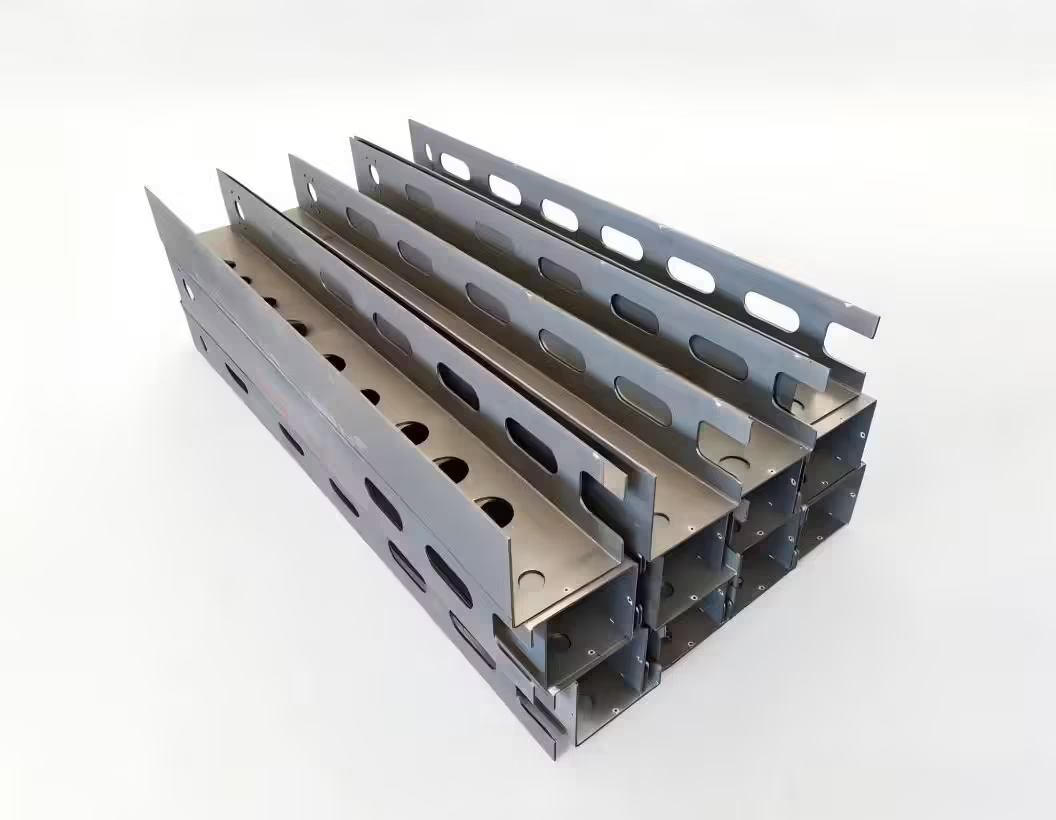
The first mistake is sending incomplete drawings. Without clear bend lines, tolerances, material details, and surface requirements, the supplier may not fully understand the project.
The second mistake is ignoring hole deformation near bend lines. Hole positions should be reviewed before cutting and bending.
The third mistake is treating welding as a separate issue. Welded assemblies require process planning from the beginning.
The fourth mistake is choosing material only by thickness. Material grade, formability, weldability, and working environment are equally important.
The fifth mistake is selecting a supplier only by basic processing capability. For OEM projects, buyers should choose a supplier that understands the full production route.
When to Use One-Stop Sheet Metal Processing
One-stop sheet metal processing is useful when the part requires multiple connected operations. If one supplier cuts the part, another supplier bends it, another welds it, and another handles finishing, quality responsibility can become unclear.
A one-stop partner can help with:
Drawing review
Material preparation
Cutting
Bending
Welding
Machining
Surface treatment coordination
Inspection
Packaging
This approach is especially useful for industrial parts used in machinery, lifting equipment, agricultural equipment, mining equipment, and steel structures. For project discussion, buyers can send drawings and requirements through the Yanghua contact page.
Conclusion
Sheet metal processing is a connected manufacturing process that requires more than cutting and bending. For OEM buyers, successful parts depend on clear drawings, suitable materials, accurate cutting, controlled bending, practical tolerances, welding planning, surface treatment, and reliable inspection.
The best results come when buyers and suppliers review the complete production route before manufacturing begins. This reduces rework, improves assembly fit, and helps maintain stable quality from prototype to batch production.
Yanghua supports customized sheet metal and steel plate processing through services such as sheet metal processing, steel plate cutting part, steel plate bending parts, and custom processing. For your next OEM metal part project, submit drawings through the Yanghua contact page to discuss a suitable sheet metal processing solution.


 English
  Arabic
  Russian